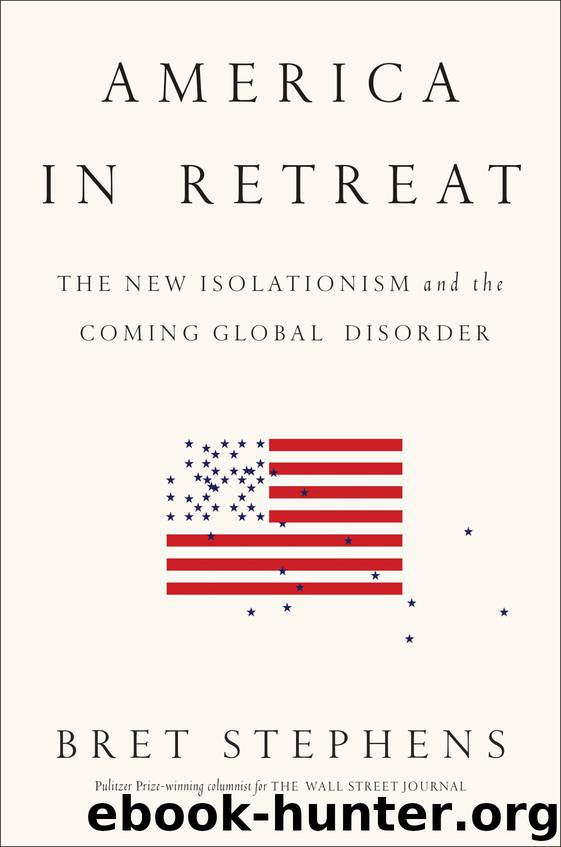
America in Retreat by Bret Stephens
Author:Bret Stephens
Language: eng
Format: epub
Publisher: Penguin Group US
Published: 2014-10-21T16:00:00+00:00
WHAT IS GLOBAL DISORDER?
Let’s be clear about what disorder is not: Disorder is not disaster—although it is frequently conducive to disaster. Disorder needn’t mean decline: the sixteenth and seventeenth centuries were a period of brutal religious strife in Europe. But they were also the years in which Europe came to dominate much of the world. Nor, finally, is disorder always a bad thing: some “orders,” such as the one Moscow brusquely imposed on its subjects from Riga to Prague to Tbilisi, richly deserved their downfalls.
Still, if disorder is not a shipwreck, it is a storm. Shipwrecks are events with abrupt causes and predictable outcomes. Storms can often be seen from a ways off, but their precise origins are obscure and their ultimate effects are unknowable. Shipwrecks are inevitably ruinous; storms, only potentially so. The victims of shipwrecks usually vanish without a trace. Storms can transform forever the lives of those who survive them. “When you come out of the storm, you won’t be the same person who walked in,” wrote the Japanese novelist Haruki Murakami in Kafka on the Shore. “That’s what this storm is all about.”
What disorder is is a high degree of unpredictability in global affairs. Aren’t global affairs always unpredictable? They are, but it’s important to distinguish between two different types of unpredictability: subsystemic and suprasystemic. To know the difference is to understand what disorder really means.
Subsystemic unpredictability is the sort we live with every day. Will a politician lose an election or die in office? Will a natural disaster in a poor country create a humanitarian crisis? Will an asset bubble burst? The answer to all three is yes, given enough time: the only question is the identity of the leader, the country, or the asset. Since we know these things are all destined to happen one way or another, we have in place various systems to make our responses as routine as possible. For the unseated leader there are laws of political succession. For the disaster-stricken country there are agencies of relief. For the asset bubble there is a kit of monetary and fiscal tools.
To speak of “global order” is to describe a world in which unpredictable events are almost always of the subsystemic kind. It’s the world most readers of this book will have known all of their lives: a world in which change tends to be cumulative and evolutionary; in which small wars may be relatively common but revolutions are rare and major-power wars are unheard of; in which the patterns of life—personal, social, economic, political, international—proceed according to a long-established set of rules, routines, and expectations. It is also a world with a certain kind of moral order, typically observed even in the breach. One of the reasons the attacks of 9/11 were such a shock to the system was that the perpetrators rejected more than just the foreign policies and political systems of the West. They also rejected the West’s moral categories, its distinctions between combatant and civilian, the guilty and the innocent—9/11 was not a subsystemic event.
Download
This site does not store any files on its server. We only index and link to content provided by other sites. Please contact the content providers to delete copyright contents if any and email us, we'll remove relevant links or contents immediately.
| Arms Control | Diplomacy |
| Security | Trades & Tariffs |
| Treaties | African |
| Asian | Australian & Oceanian |
| Canadian | Caribbean & Latin American |
| European | Middle Eastern |
| Russian & Former Soviet Union |
The Secret History by Donna Tartt(19088)
The Social Justice Warrior Handbook by Lisa De Pasquale(12190)
Thirteen Reasons Why by Jay Asher(8910)
This Is How You Lose Her by Junot Diaz(6887)
Weapons of Math Destruction by Cathy O'Neil(6280)
Zero to One by Peter Thiel(5802)
Beartown by Fredrik Backman(5754)
The Myth of the Strong Leader by Archie Brown(5508)
The Fire Next Time by James Baldwin(5446)
How Democracies Die by Steven Levitsky & Daniel Ziblatt(5219)
Promise Me, Dad by Joe Biden(5153)
Stone's Rules by Roger Stone(5088)
A Higher Loyalty: Truth, Lies, and Leadership by James Comey(4964)
100 Deadly Skills by Clint Emerson(4925)
Rise and Kill First by Ronen Bergman(4789)
Secrecy World by Jake Bernstein(4753)
The David Icke Guide to the Global Conspiracy (and how to end it) by David Icke(4720)
The Farm by Tom Rob Smith(4513)
The Doomsday Machine by Daniel Ellsberg(4490)
